
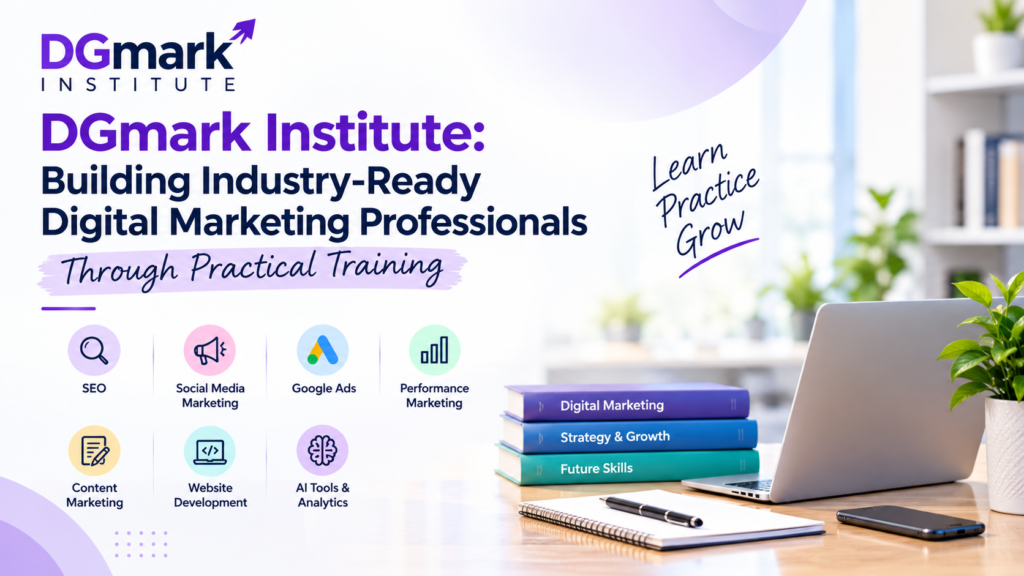
DGmark Institute: Building Industry-Ready Digital Marketing Professionals Through Practical Training
Introduction: Why Practical Digital Marketing Skills Matter
Digital marketing has become an important part of how businesses communicate with customers, promote products and services, generate leads, and build their brands. From search engines and social media platforms to paid advertising, websites, content marketing, and analytics, businesses now use a wide range of digital channels to reach their audiences.
This growing dependence on digital platforms has also increased the demand for professionals who understand how these channels work in practice. Knowing the definition of SEO or social media marketing is different from being able to plan a campaign, analyze results, optimize performance, and make informed marketing decisions.
For aspiring digital marketers, this creates an important question: How can they develop skills that are relevant to actual industry requirements?
One approach is practical, project-based education that combines digital marketing concepts with opportunities to apply them. This is the approach highlighted by DGmark Institute, a digital marketing training institute offering classroom and online learning options, practical projects, mentorship, and career-oriented training. Its website describes a curriculum covering areas such as SEO, Google Ads, social media, performance marketing, AI tools, and other digital marketing skills.
The institute currently lists a six-month Certification in Advanced Digital Marketing, a 12-month Diploma in Advanced Digital Marketing, and a three-month online digital marketing program.
The broader idea behind such training is straightforward: digital marketing professionals need more than theoretical knowledge. They need opportunities to understand how marketing strategies are created, implemented, measured, and improved.
What Does It Mean to Be an Industry-Ready Digital Marketer?
Being an industry-ready digital marketer does not simply mean completing a course or receiving a certificate. It involves developing a combination of technical knowledge, practical ability, analytical thinking, creativity, and communication skills.
A marketer working on a real campaign may need to research keywords, understand a target audience, create content, manage social media activities, plan paid advertising, monitor website performance, and study campaign data. These responsibilities require the ability to connect different areas of digital marketing rather than treating each skill as an isolated subject.
For example, SEO involves much more than adding keywords to a website. A marketer may need to understand keyword research, search intent, on-page optimization, technical issues, content quality, internal linking, local SEO, and performance measurement.
Similarly, social media marketing is not limited to publishing posts. A social media professional needs to understand audience behavior, content planning, platform-specific strategies, engagement, campaign objectives, and performance analysis.
Paid advertising also requires practical understanding. Campaign objectives, audience targeting, budgets, ad creatives, landing pages, tracking, conversions, and optimization all influence campaign performance.
This is why practical exposure can play an important role in digital marketing education. Learners can better understand the connection between strategy, execution, measurement, and optimization when they get opportunities to apply what they study.
DGmark Institute’s Practical Approach to Digital Marketing Education
DGmark Institute positions practical training as a central part of its digital marketing education. The institute’s website highlights hands-on projects, expert mentorship, live projects, real client campaign exposure, case studies, and industry-oriented learning.
This practical approach is particularly relevant in digital marketing because many concepts become clearer when learners can see how they work in an actual marketing situation.
Consider keyword research as an example. A student may understand the definition of keyword research from a textbook, but working on a website can introduce additional questions:
- What is the search intent behind a keyword?
- Which keywords are relevant to a particular business?
- How competitive is a keyword?
- Where should keywords be used?
- How can search performance be monitored?
The same principle applies to advertising. Understanding the terminology behind Google Ads or social media advertising is useful, but creating a campaign structure, selecting an audience, preparing ad messaging, setting objectives, and reviewing performance can provide a much more practical understanding of the process.
DGmark Institute’s website states that its curriculum is designed around practical, industry-ready training and includes updated areas such as AI tools, performance marketing strategies, SEO developments, and real-time case studies.
For learners, this type of education can help bridge the gap between learning a concept and understanding how that concept is applied.
Learning the Core Areas of Digital Marketing
Digital marketing is a broad field. Professionals can specialize in one area or develop knowledge across multiple disciplines. A structured digital marketing course can therefore provide learners with exposure to several important areas.
Search Engine Optimization
Search Engine Optimization, commonly known as SEO, focuses on improving a website’s visibility in search engines.
A practical understanding of SEO can include keyword research, on-page SEO, technical SEO, off-page SEO, local SEO, content optimization, and performance analysis.
SEO is also an area where results can take time and require continuous monitoring. Search behavior, competition, website quality, content, and search-engine changes can all affect visibility.
Learning these concepts through practical exercises can help students understand SEO as an ongoing process rather than a one-time activity.
Social Media Marketing : Social media has become another important component of digital communication.
A social media marketer may be involved in content planning, audience research, profile optimization, campaign development, community engagement, paid promotions, and performance measurement.
Different platforms also have different audiences and content formats. A strategy that works on one platform may not necessarily work in the same way on another.
Practical training can help learners understand how social media strategies are developed around specific business objectives instead of simply focusing on posting content regularly.
Google Ads and Paid Advertising
Paid advertising allows businesses to reach specific audiences through online advertising platforms.
Digital marketing professionals working with paid campaigns may need to understand campaign objectives, keyword targeting, audience selection, ad copy, budgets, landing pages, conversion tracking, and optimization.
The ability to analyze campaign data is particularly important. Marketers need to understand what the numbers are indicating and determine what changes may improve campaign performance.
This is another area where practical exercises can help learners move beyond theoretical understanding.
Performance Marketing and Analytics
Performance marketing places strong emphasis on measurable outcomes.
Depending on the campaign, marketers may monitor metrics such as clicks, impressions, leads, conversions, engagement, cost per acquisition, and return on advertising investment.
Analytics helps marketers understand what is happening after a campaign goes live.
For an aspiring digital marketer, developing data interpretation skills can therefore be just as important as learning how to create campaigns.
Website and Content Skills
A business’s digital presence often depends on its website and content.
Digital marketers may work with landing pages, blogs, website copy, calls to action, product pages, and other forms of digital communication.
Understanding how content and websites contribute to marketing objectives can help learners develop a broader perspective of the customer journey—from discovering a business online to taking an action such as submitting an enquiry, making a purchase, or contacting the company.
The Role of AI in Modern Digital Marketing Training
Artificial intelligence is becoming increasingly relevant to the way digital marketers research, create, analyze, and optimize marketing activities. From content ideation and customer research to data analysis and workflow automation, AI tools can support marketers across different stages of a campaign.
For someone learning digital marketing today, understanding AI is therefore becoming an additional professional skill.
DGmark Institute highlights AI-integrated learning and AI tools within its digital marketing training approach. This reflects a broader shift in the industry, where marketers are increasingly expected to understand how emerging technologies can be incorporated into everyday marketing workflows.
AI can assist marketers with tasks such as:
- Generating content ideas
- Organizing research
- Identifying content opportunities
- Supporting keyword research
- Creating campaign concepts
- Analyzing large amounts of information
- Developing content variations
- Improving workflow efficiency
- Supporting customer communication
However, learning AI should not mean depending entirely on automated tools.
A successful digital marketing strategy still requires human decision-making. Marketers need to understand the target audience, business objectives, brand positioning, customer behavior, and campaign data. AI can assist with productivity and analysis, but marketers still need to determine whether an idea is relevant, accurate, useful, and appropriate for a particular audience.
This makes AI education particularly valuable when it is combined with traditional digital marketing fundamentals.
A learner who understands SEO, advertising, content strategy, analytics, and audience research can potentially make more informed use of AI than someone who simply knows how to generate content with an AI tool.
From Classroom Learning to Real-World Application
One of the challenges associated with learning digital marketing is understanding how individual concepts connect in a real campaign.
For example, SEO, content, social media, paid advertising, and analytics may be taught as separate subjects. In an actual business environment, however, these activities can influence one another.
A company may publish a blog to attract organic traffic, promote that content through social media, run a paid campaign to reach a targeted audience, and then use analytics to understand how visitors interact with the website.
Practical projects can help learners see these connections.
DGmark Institute’s website highlights live projects, practical assignments, case studies, and real client campaign exposure as elements of its training approach. Such activities can give students opportunities to think about marketing beyond classroom definitions.
The value of project-based learning is that it can introduce questions that do not always appear in theoretical lessons.
For instance:
What happens if a campaign receives clicks but very few conversions?
The answer may require examining the advertisement, audience targeting, landing page, offer, messaging, or tracking setup.
Similarly:
What happens when website traffic increases but enquiries do not?
A marketer may need to investigate user experience, content relevance, calls to action, page speed, audience quality, or conversion pathways.
These situations encourage learners to think like marketers rather than simply memorize concepts.
Building a Digital Marketing Portfolio
A certificate can demonstrate that someone has completed a particular learning program, but a portfolio can provide another way to demonstrate practical skills.
For students and aspiring professionals, building a portfolio during training can be useful because it provides tangible examples of their work.
A digital marketing portfolio might include:
- Keyword research projects
- SEO audits
- Website optimization examples
- Social media content calendars
- Social media campaign strategies
- Google Ads campaign structures
- Meta Ads campaign plans
- Blog writing samples
- Content strategies
- Analytics reports
- Marketing case studies
The purpose of a portfolio is not simply to make a collection of documents. Each project should demonstrate a person’s ability to identify a marketing objective, develop an approach, execute relevant tasks, and evaluate the outcome.
For example, instead of simply writing “SEO” on a resume, a candidate could demonstrate an SEO project that includes keyword research, competitor analysis, on-page recommendations, content planning, and performance observations.
This can make practical learning more visible when applying for opportunities.
Career Opportunities After Digital Marketing Training
Digital marketing is a broad professional field, which means learners can explore different areas based on their interests and developing skills.
Possible career paths include:
Digital Marketing Executive
A digital marketing executive may work across several online marketing activities, including content, SEO, social media, email marketing, and campaign coordination.
This role can provide exposure to multiple areas of digital marketing.
SEO Executive or Specialist
People interested in search engines can focus on keyword research, on-page optimization, technical SEO, content optimization, local SEO, and website performance.
SEO professionals often work with content and website teams to improve organic search visibility.
Social Media Executive
Social media professionals may be responsible for planning content, managing social profiles, monitoring engagement, coordinating campaigns, and reviewing social media performance.
Performance Marketing Executive
Performance marketing roles can involve paid advertising, campaign management, audience targeting, conversion tracking, and data analysis.
These professionals often need to make decisions based on measurable campaign results.
Content Marketing Professional
Content-focused roles involve developing useful and relevant content for websites, blogs, social platforms, email campaigns, and other digital channels.
Freelance Digital Marketer
Digital marketing skills can also be applied in freelance work. Freelancers may provide specialized services such as SEO, social media management, paid advertising, content marketing, or website optimization.
The career path a learner follows can depend on specialization, experience, portfolio quality, communication skills, and the requirements of individual employers or clients.
Completing training does not automatically guarantee employment or a particular career outcome. Continuous skill development and practical experience remain important in a changing industry.
Who Can Consider Digital Marketing Training?
Digital marketing education is not limited to one type of learner. People with different educational and professional backgrounds can explore the field depending on their goals.
Students
Students can use digital marketing training to develop an additional professional skill set alongside their formal education.
Learning areas such as SEO, social media, advertising, analytics, and content can help students understand how modern businesses approach online marketing.
Working Professionals
Professionals from other fields may explore digital marketing as an opportunity to add new skills to their existing experience.
For example, someone with sales, communication, design, business development, or customer service experience may find digital marketing useful as an additional area of expertise.
Freelancers
Freelancers can learn digital marketing to expand the range of services they can offer to clients.
A freelancer specializing in content, web development, graphic design, or another related area may also benefit from understanding how their work contributes to broader marketing objectives.
Entrepreneurs
Business owners can benefit from understanding digital marketing even when they do not personally manage every campaign.
Knowledge of SEO, paid advertising, social media, content, and analytics can help entrepreneurs communicate more effectively with marketing teams and evaluate digital marketing activities.
Career Switchers
People considering a career change may explore digital marketing as a new professional skill area.
For career switchers, structured learning combined with practical assignments and portfolio development can provide a framework for building foundational knowledge.
Why Practical Training Matters in a Fast-Changing Industry
Digital marketing does not remain static.
Search engine algorithms change. Advertising platforms introduce new features. Social media platforms evolve. Consumer behavior shifts. Analytics systems develop. Artificial intelligence continues to introduce new tools and workflows.
As a result, digital marketers need to treat learning as an ongoing process.
A course can provide a foundation, but professionals must continue developing their skills through experimentation, industry updates, practical projects, and continued education.
This is one reason practical training can be valuable. Instead of learning digital marketing as a fixed collection of definitions, students can develop a mindset of testing, measuring, learning, and adapting.
The ability to ask “What is working, why is it working, and what can be improved?” is central to effective digital marketing.
For aspiring professionals, this mindset can be as important as learning individual tools.
DGmark Institute’s Learning Ecosystem
DGmark Institute presents its programs around a combination of digital marketing concepts, practical learning, projects, mentorship, and career-oriented development. Its website highlights areas including SEO, social media marketing, Google Ads, performance marketing, AI tools, analytics, content marketing, and other digital marketing disciplines.
The institute also describes features such as live projects, assignments, case studies, portfolio development, internships, certification, and career support as components associated with its training programs.
These elements are relevant because digital marketing requires a combination of knowledge and application.
A learner may understand how a marketing channel works, but practical exercises can provide an opportunity to experience the decisions involved in using that channel.
The overall objective of industry-oriented education is therefore not simply to cover a large number of topics. It is to help learners understand how different digital marketing skills can work together to address business objectives.