
The way customers discover and evaluate businesses has changed significantly. Before contacting a company, many people now begin their journey online. They may search on Google, visit a website, explore social media profiles, read reviews, compare services, and then decide whether to make an enquiry or purchase.
For businesses, this shift has made digital visibility an important part of building trust and reaching potential customers. However, simply being present online does not necessarily create meaningful results. A business needs a clear strategy that connects its website, search visibility, advertising, social media activity, content, and customer journey.
This is where digital marketing plays an important role.
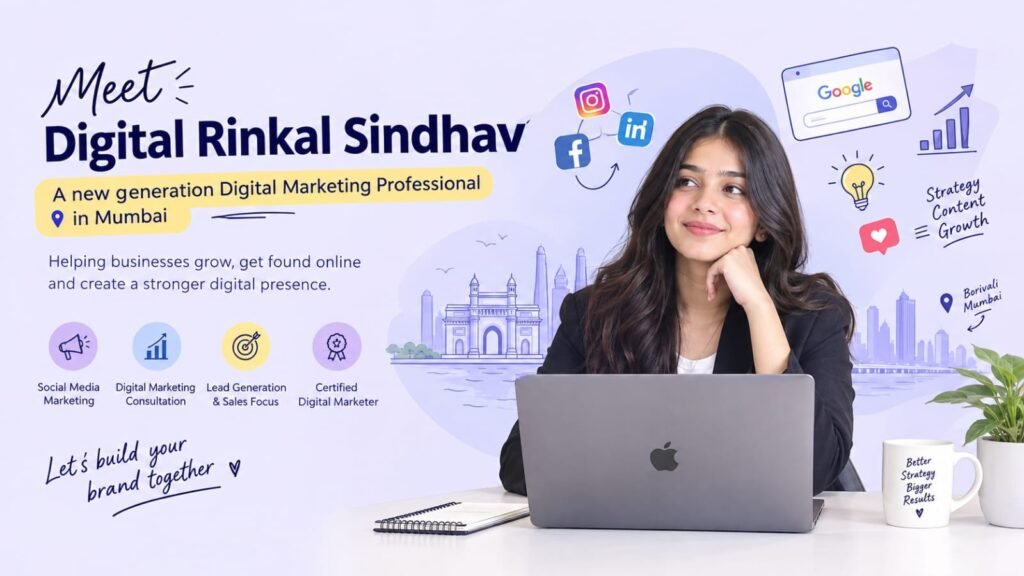
Digital Rinkal Sindhav is building her professional identity around helping businesses understand and use digital marketing to strengthen their online presence. Based in Borivali, Mumbai, her work focuses on areas such as SEO, Google Ads, Meta Ads, social media marketing, local SEO, website development, and digital marketing strategy.
As a digital marketer in Borivali, Mumbai, Rinkal focuses on the practical side of online marketing—understanding business objectives, identifying relevant audiences, selecting suitable digital channels, and using measurable indicators to evaluate marketing activities.
The Changing Digital Landscape for Mumbai Businesses
Mumbai is home to businesses operating across a wide range of industries, from local service providers and professionals to startups, retailers, consultants, and growing companies. Their digital requirements can be very different.
A local service provider may want more enquiries from people searching within a specific area. An online business may focus on website traffic and conversions. A professional may want to establish personal credibility through content and LinkedIn. A retail business may use social media and paid advertising to attract potential customers.
These different objectives demonstrate why digital marketing cannot always follow a single formula.
A business may have a website but receive very little organic traffic. Another may receive website visitors but struggle to turn them into enquiries. A company may have an active Instagram profile but lack a structured method for measuring whether its social media activity contributes to business objectives.
Looking at these situations through measurable indicators can help identify where improvement may be required.
For example, website performance can be evaluated through metrics such as:
- Organic traffic
- Keyword visibility
- Click-through rate
- Website enquiries
- Conversion rate
- Landing-page performance
- Returning visitors
Similarly, paid advertising can be assessed through metrics such as impressions, clicks, click-through rate, cost per click, cost per lead, conversions, and return on ad spend.
Social media can also be evaluated using indicators such as reach, engagement, profile visits, audience growth, and traffic generated from social platforms.
The purpose of measuring these numbers is not simply to collect reports. The numbers can help marketers understand what is happening and identify areas that may require adjustment.
Who Is Digital Rinkal Sindhav?
Digital Rinkal Sindhav is a digital marketing professional from Borivali, Mumbai, with a focus on helping businesses establish and strengthen their online presence.
Her professional approach covers multiple areas of digital marketing rather than treating each channel as an isolated activity. Search engine optimization, paid advertising, social media marketing, content, websites, and local search can work together when they are planned around a common business objective.
For instance, SEO can help a business improve its visibility for relevant search queries over time, while Google Ads can provide paid visibility for selected search terms. Social media can support communication and brand awareness, while a well-structured website can provide the destination where visitors learn about services and take action.
This interconnected approach is important because a customer’s online journey rarely depends on a single interaction.
Someone may first discover a business through a Google search, visit its website later, see its social media content, check reviews, and eventually submit an enquiry. Each digital touchpoint can contribute to the overall customer experience.
For this reason, Rinkal’s professional focus is not limited to creating individual campaigns. It also involves understanding how different digital activities can contribute to a broader online marketing strategy.
Her website, rinkalsindhav.in, serves as a platform for presenting her professional identity, digital marketing services, and areas of expertise. Her LinkedIn profile also provides another professional touchpoint for people interested in learning more about her work and background.
Why Businesses Need a Structured Digital Marketing Strategy
One of the challenges businesses face is deciding where to invest their time and marketing budget.
There are numerous digital channels available today. A business could work on SEO, publish blogs, run Google Ads, advertise on Meta platforms, create short-form videos, maintain social media profiles, optimize its Google Business Profile, send email campaigns, or improve its website.
Trying to do everything at once can make marketing difficult to manage.
A structured strategy begins by identifying what the business actually wants to achieve.
For example, objectives may include:
- Increasing relevant website traffic
- Generating qualified leads
- Improving local search visibility
- Increasing enquiries
- Building brand awareness
- Improving website conversions
- Reducing inefficient advertising expenditure
- Establishing stronger digital credibility
Once the objective is clear, the next step is to understand the target audience.
A marketing strategy for a local dentist will differ from one designed for an e-commerce store. Similarly, the digital approach for a business targeting customers in Borivali may differ from a company targeting customers across India.
Audience, location, search intent, competition, budget, products, services, and customer behaviour all influence the strategy.
This is why personalization can be an important part of digital marketing.
From Digital Presence to Measurable Performance
Having an online presence is only the starting point.
The more important question is what happens after a business becomes visible.
Suppose a website receives 1,000 visitors in a month but generates only a small number of enquiries. Looking only at traffic may give an incomplete picture. The business may need to examine its landing pages, calls to action, service information, user experience, or audience relevance.
Similarly, consider a hypothetical Google Ads campaign that receives many clicks but produces very few enquiries. The issue may not simply be the number of clicks. It could involve search intent, keyword selection, advertisement messaging, landing-page experience, or conversion tracking.
These examples demonstrate why quantitative measurement can support better marketing decisions.
Instead of asking only, “Is the campaign working?”, a marketer can examine more specific questions:
- How many relevant users reached the website?
- How many completed the desired action?
- What was the conversion rate?
- Which keywords generated meaningful traffic?
- How much did each lead cost?
- Which campaign or landing page generated more conversions?
- Where are potential customers leaving the journey?
The answers provide a more detailed picture of performance.
For Digital Rinkal Sindhav, this data-oriented perspective forms an important part of understanding digital marketing as a business function rather than simply an online promotional activity.
Here is Part 2, continuing directly from Part 1. I’m keeping the same editorial tone, quantitative approach, and natural use of your primary keyword.
SEO: Building Visibility Through Search
Search engine optimization is one of the core areas of digital marketing because search engines can connect businesses with people who are already looking for specific information, products, or services.
SEO involves much more than adding keywords to a website. It can include technical improvements, content optimization, internal linking, keyword research, local search optimization, website structure, and building relevant authority.
For a business, one useful way to evaluate SEO is by looking at measurable changes over time.
These may include:
- Organic search impressions
- Organic clicks
- Keyword positions
- Organic website sessions
- Pages receiving search traffic
- Click-through rate
- Leads generated through organic search
For example, a business targeting a service-related keyword may initially receive search impressions without receiving many clicks. Improving the page title and description may influence the click-through rate. Further improvements to the content, structure, and relevance of the page may help it compete for more relevant searches.
SEO is generally a long-term activity. Rankings can change because of competition, search behaviour, website changes, algorithm updates, and many other factors. Therefore, ongoing monitoring is important.
For local businesses, SEO also has a geographical dimension.
A company serving customers in Borivali, for example, may want to become more visible when potential customers search for relevant services in or around the area. This makes local SEO particularly relevant for businesses whose customers are location-dependent.
Google Ads: Reaching Customers With Search Intent
While SEO focuses on organic search visibility, Google Ads can provide businesses with paid opportunities to appear for selected searches.
One of the major advantages of search advertising is the ability to connect advertisements with specific search intent. Someone actively searching for a particular service may already have a defined requirement.
However, running advertisements does not automatically guarantee useful leads.
Campaign performance needs to be monitored using measurable indicators such as:
- Impressions
- Clicks
- Click-through rate
- Cost per click
- Conversions
- Cost per conversion
- Conversion rate
- Return on ad spend
Consider a hypothetical campaign with 1,000 impressions and 50 clicks. The click-through rate in this example would be 5%. If 5 of those visitors completed the desired action, the conversion rate from clicks would be 10%.
These numbers alone do not determine whether a campaign is successful because the value of each conversion, the advertising cost, lead quality, and business objective also matter. However, they provide a framework for understanding campaign performance.
A structured Google Ads strategy can therefore involve keyword selection, audience considerations, advertisement messaging, landing-page relevance, conversion tracking, and continuous optimization.
The objective is not simply to generate clicks. The objective is to make the advertising activity relevant to the business goal.
Meta Ads: Connecting Businesses With Target Audiences
Facebook and Instagram provide another environment for businesses to reach potential customers.
Meta advertising can be useful for businesses that want to introduce products, generate leads, promote services, build awareness, or reconnect with people who have previously interacted with their digital presence.
Unlike search advertising, where a user may actively search for a service, social advertising can reach people while they are browsing content.
This difference makes creative strategy and audience relevance particularly important.
A Meta campaign can be evaluated using metrics such as:
- Reach
- Impressions
- Frequency
- Link clicks
- Click-through rate
- Cost per click
- Leads
- Cost per lead
- Conversion rate
Creative testing can also provide useful insights.
For example, a business could test two different advertisement messages with similar audiences and compare their click-through rates or lead generation. If one version produces more relevant actions at a similar cost, the business has data that can inform future campaigns.
This type of testing turns advertising into an ongoing learning process rather than a one-time activity.
Social Media Marketing: More Than Posting Content
Social media has become an important communication channel for many businesses. However, maintaining a social media profile should involve more than publishing posts whenever content is available.
A structured social media strategy begins with understanding the audience and deciding what the business wants its content to achieve.
Depending on the business, content may be designed to:
- Educate potential customers
- Explain products or services
- Answer common questions
- Demonstrate expertise
- Build brand familiarity
- Share business updates
- Encourage enquiries
- Generate website visits
Different types of content can serve different stages of the customer journey.
An educational post may introduce a problem. A detailed explanation may help the audience understand a solution. A service-focused post can explain how the business addresses that problem. A customer review or case study, when genuine and properly documented, can provide additional context.
Social media performance can be measured through indicators such as reach, engagement rate, profile visits, website clicks, follower growth, and enquiries.
The exact metrics that matter depend on the objective.
If the objective is awareness, reach and impressions may provide useful information. If the objective is lead generation, enquiries and conversion-related metrics become more relevant.
This distinction helps businesses avoid judging every social media campaign using the same measurement system.
Local SEO: Connecting With Nearby Customers
For businesses serving a specific geographical area, local SEO can play an important role in digital visibility.
A potential customer may not simply search for a generic service. They may include a location in their search because proximity matters.
For example, someone could search for a service using a neighbourhood, suburb, or city name.
This creates an opportunity for businesses to optimize their online presence around relevant local searches.
Local SEO can involve areas such as:
- Google Business Profile optimization
- Accurate business information
- Local keywords
- Customer reviews
- Location-specific website content
- Business directories and citations
- Local landing pages
- Consistent contact information
Google Business Profile can be particularly relevant for local businesses because it can help customers discover basic business information through Google Search and Maps.
Important information may include business category, services, operating details, website, contact information, photos, and customer reviews.
For a business operating in Borivali, local visibility can be an important part of reaching customers in the surrounding market.
This is one reason the work of a digital marketer in Borivali, Mumbai can involve understanding both broader digital marketing principles and the practical requirements of local businesses.
Website Optimization: Turning Visitors Into Actions
A website often acts as the central destination for digital marketing activity.
SEO may bring organic visitors. Google Ads can bring paid visitors. Social media can generate referral traffic. Local search can introduce nearby customers.
But once people arrive on the website, the website needs to help them understand what the business offers and what they should do next.
Website optimization can involve:
- Clear service descriptions
- Easy navigation
- Mobile-friendly design
- Relevant calls to action
- Fast-loading pages
- Well-structured content
- Simple enquiry processes
- Trust-building information
- Strong landing pages
Consider a hypothetical website receiving 2,000 monthly visitors. If 20 visitors submit an enquiry, the conversion rate would be 1%. If improvements increase enquiries to 40 while traffic remains at approximately 2,000 visitors, the conversion rate would become 2%.
This example illustrates an important point: business growth does not always require only more traffic. Improving the percentage of visitors who take meaningful action can also influence performance.
This is why SEO, advertising, content, and website optimization should not always be considered separate activities.
They can influence different stages of the same customer journey.
Creating a Connected Digital Marketing System
A strong digital presence is often created through multiple activities working together.
SEO can help people discover a business through organic search. Paid advertising can provide additional visibility. Social media can support communication and awareness. Local SEO can help location-based businesses reach nearby audiences. A website can provide detailed information and facilitate conversions.
The role of strategy is to connect these activities with a common objective.
For example, a local business could use SEO to target relevant service searches, optimize its Google Business Profile for local discovery, publish educational content on social media, and use a conversion-focused website to handle enquiries.
Performance can then be evaluated across different stages.
Instead of looking only at follower numbers or website traffic, the business can examine whether these activities are contributing to relevant enquiries, conversions, and other defined business outcomes.
This is where a data-driven approach becomes valuable.
A Data-Driven Approach to Digital Marketing
Digital marketing becomes more useful when businesses can measure what is happening and use those observations to improve their strategy.
A campaign may generate thousands of impressions, but impressions alone do not indicate whether the right audience was reached. Similarly, a website may receive increasing traffic without generating a corresponding increase in enquiries.
This is why digital marketing performance can be examined through multiple stages of the customer journey.
Some commonly monitored indicators include:
- Website traffic
- Search impressions
- Keyword positions
- Click-through rate
- Conversion rate
- Leads generated
- Cost per lead
- Cost per click
- Social media engagement
- Advertising return on spend
These numbers should be interpreted according to the business objective.
For example, a hypothetical website receives 3,000 visitors in one month and generates 30 enquiries. Its enquiry conversion rate would be 1%. If website improvements result in 45 enquiries from the same 3,000 visitors, the conversion rate would increase to 1.5%.
The example demonstrates why increasing traffic is not always the only opportunity. Improving the experience for existing visitors can also be important.
Similarly, suppose an advertising campaign generates 100 leads but only 10 are considered relevant by the sales team. The headline lead count may look substantial, but the business may need to investigate lead quality, targeting, advertisement messaging, and the customer journey.
Quantitative measurement therefore works best when numbers are connected to business objectives.
Personalization in Digital Marketing
Every business has its own combination of products, services, customers, location, budget, competition, and business goals.
Because of this, a strategy that works for one business may not automatically be appropriate for another.
A local professional may need to focus heavily on reputation, local search visibility, and enquiries. An e-commerce company may prioritize product pages, shopping campaigns, conversion optimization, and repeat purchases. A startup may initially focus on awareness and audience discovery.
This makes personalization an important part of digital marketing.
Digital Rinkal Sindhav’s approach can be understood around the idea of creating strategies according to the individual requirements of a business rather than applying the same marketing plan everywhere.
The process can begin with understanding the business itself.
Questions may include:
- Who is the target customer?
- What problem does the business solve?
- Where do potential customers search for solutions?
- What makes the business different?
- Which digital channels are already producing results?
- What are the current challenges?
- What should the marketing activity achieve?
- Which metrics should be monitored?
The answers can help determine which digital channels deserve attention.
This approach can also help businesses use their resources more deliberately.
Instead of trying to maintain every available platform, a business can prioritize channels that are relevant to its audience and objectives.
Understanding the Customer Journey
Customers rarely make decisions based on a single digital interaction.
A person may discover a business through Google, visit its website, follow its social media account, read reviews, return to the website later, and finally make an enquiry.
This means that different marketing channels can support different stages of the decision-making process.
A simplified customer journey may look like:
Discovery → Research → Evaluation → Enquiry → Conversion → Retention
SEO and social media can contribute to discovery. Website content can support research. Reviews and service information can influence evaluation. Clear calls to action can encourage enquiries.
After a customer converts, communication and service quality become important for retention and repeat business.
Understanding this journey can help businesses avoid evaluating every channel using the same metric.
For example, social media content may contribute to awareness even when it does not immediately generate a direct enquiry. Meanwhile, a search advertisement may be evaluated more directly through conversions and cost per lead.
The role of measurement is to understand these differences rather than treating every digital activity as identical.
Building Long-Term Digital Visibility
Digital marketing is not generally a one-time task.
Search rankings can change. Competitors can publish new content. Advertising costs can fluctuate. Customer behaviour can evolve. Social media platforms can introduce new formats and features.
For these reasons, businesses need to review and improve their digital presence continuously.
Long-term digital visibility can involve activities such as:
- Updating website content
- Monitoring keyword performance
- Improving technical SEO
- Reviewing Google Business Profile information
- Creating useful content
- Testing advertisements
- Analyzing website behaviour
- Reviewing conversion performance
- Monitoring relevant competitors
- Improving landing pages
Regular measurement can reveal patterns that may not be obvious from a single campaign report.
For example, a business may notice that certain pages consistently generate more enquiries than others. That observation could lead to further content development around similar topics.
Another business may discover that mobile users form a significant portion of its website visitors but have a lower conversion rate. This could encourage the business to examine its mobile experience and enquiry process.
These are examples of how data can guide optimization.
The Importance of Local Digital Marketing in Mumbai
Mumbai businesses operate within a diverse and competitive environment, and local visibility can be especially important for businesses that serve customers within specific neighbourhoods.
For a local service provider, being visible to a person searching nearby can be more relevant than simply attracting visitors from a wider geographical area.
This makes local SEO, location-specific content, Google Business Profile optimization, and reputation management useful components of a broader digital strategy.
Borivali is one of the areas where businesses can benefit from a locally relevant digital approach.
A business serving Borivali may also attract customers from nearby areas such as Kandivali, Dahisar, Malad, or other parts of Mumbai, depending on its services and customer base.
The strategy should therefore reflect the actual service area rather than assuming that every business needs the same geographical targeting.
For a digital marketer in Borivali, Mumbai, understanding this local context can help connect broader digital marketing techniques with location-based customer discovery.
Digital Rinkal Sindhav’s Professional Approach
Digital Rinkal Sindhav’s professional positioning is centered around digital marketing and helping businesses strengthen their online presence.
Her work spans several areas, including SEO, Google Ads, Meta Ads, social media marketing, local SEO, website development, and broader digital marketing strategy.
The common thread across these areas is the need to connect marketing activity with a business objective.
Rather than viewing SEO, advertising, social media, and websites as completely separate functions, they can be considered parts of a larger digital ecosystem.
For example, SEO can support organic discovery, while Google Ads can provide paid search visibility. Social media can create additional communication opportunities, while a website can provide the information and conversion environment needed after someone discovers the business.
A strategy can then be evaluated using relevant performance indicators.
This approach also leaves room for adjustment.
If a particular activity is not producing the expected outcome, the answer does not necessarily mean abandoning digital marketing altogether. The business may need to examine the audience, message, channel, landing page, offer, budget, or measurement process.
This continuous process of testing, measuring, learning, and improving is an important part of modern digital marketing.
Looking Ahead: The Future of Digital Marketing
The digital environment will continue to evolve as customer behaviour, search technology, advertising platforms, social media, and artificial intelligence develop.
Businesses may increasingly need to think beyond traditional search rankings and social media posting.
Customers can discover information through multiple digital touchpoints, and businesses need to provide useful, accurate, and accessible information across those touchpoints.
Artificial intelligence is also influencing how people create and consume content. For marketers, this creates opportunities to improve research, ideation, analysis, and productivity while also making originality, accuracy, and human judgment important.
The growing importance of measurable performance is another continuing trend.
Businesses increasingly need to understand not only how many people they reached, but also what those people did afterward.
Questions such as these can become increasingly relevant:
- Did the visitor engage with the website?
- Did they contact the business?
- Did they complete a purchase?
- Which channel contributed to the conversion?
- How much did acquiring that customer cost?
- Which marketing activity produced the most relevant outcome?
These questions shift digital marketing from simply being an online visibility exercise toward a more measurable business activity.
Building a Stronger Digital Presence With Purpose
A strong digital presence is not created by being active on every platform.
It is created by understanding where potential customers spend their time, what information they need, what questions they ask, and what factors influence their decisions.
For businesses in Mumbai, this may involve combining local search visibility with a professional website, useful content, social media communication, paid advertising, and consistent measurement.
The right combination depends on the business.
For some companies, SEO may be a major long-term priority. For others, paid advertising may be more relevant to immediate lead generation. A local business may benefit from focusing strongly on Google Business Profile and local search. A professional may use content and LinkedIn to develop authority and visibility.
There is no single digital marketing formula that automatically fits every business.
Instead, the focus can remain on creating a clear objective, selecting appropriate channels, measuring meaningful outcomes, and improving the strategy over time.
Conclusion
Digital marketing has become an important part of how businesses communicate with potential customers, establish credibility, and generate opportunities online.
From SEO and Google Ads to Meta Ads, social media, local SEO, and website optimization, each digital channel can serve a different purpose. When these channels are connected through a clear strategy, businesses can create a more consistent digital customer journey.
For Digital Rinkal Sindhav, digital marketing represents an opportunity to help businesses approach online growth with greater structure and measurable objectives.
Her professional focus as a digital marketer in Borivali, Mumbai reflects the growing importance of combining digital expertise with an understanding of local business requirements.
As the digital landscape continues to change, businesses will need to keep learning, measuring, testing, and adapting. A strong online presence is therefore not simply about being visible. It is about being relevant, useful, measurable, and connected to genuine business objectives.
Digital Rinkal Sindhav’s journey in digital marketing reflects this broader shift: helping businesses look at their online presence not as a collection of individual platforms, but as a connected ecosystem designed to support visibility, customer engagement, and sustainable business growth.